
The Hidden Operational Cost of Distrust
- Dr. Jeff Doolittle

- Jun 8
- 6 min read
Amid increasing uncertainty, building trust is both more difficult and more important for executive leadership teams. Many organizations view trust as a part of their culture. In reality, trust is an operational necessity. When trust declines, decision-making slows, collaboration weakens, and resistance to change increases. Distrust introduces friction that slows decision-making, reduces information flow, and weakens alignment, ultimately degrading execution and performance.
Evidence from a large global study suggests fewer than one-third of employees are willing to help, live near, or work alongside someone who disagrees with their point of view on issues that matter (Edelman Trust Institute). As polarization in society increases, leaders face a growing challenge of maintaining trust while leading change.
Trust is the currency of business. It holds organizations together during uncertainty. Executive leaders are expected to provide vision, guide strategy, and lead transformation. Yet many leaders privately wonder whether it is possible to be viewed as trustworthy while asking others to embrace significant change.
The good news is that trust can be strengthened, even after it has been damaged. However, trust is rarely restored through communication alone. Employees evaluate whether leadership decisions, behaviors, and actions consistently align with organizational values and commitments. Understanding how trust is built and lost is a strategic leadership responsibility.

Why executive leadership trust matters
Numerous studies demonstrate that leadership is a critical determinant of successful organizations and change. Regardless of whether a change is department-specific or company-wide, it benefits from executive engagement.
Executive leadership teams provide vision, establish strategy, prepare the corporate culture for change, and motivate employees to change. This is important because trust has been shown to mediate employee openness to change and, ultimately, the outcome of change.
When trust is present, organizations navigate and manage change more effectively. Change events heighten emotional responses, making it challenging for even the most skilled leaders to communicate effectively.
The hidden cost of distrust
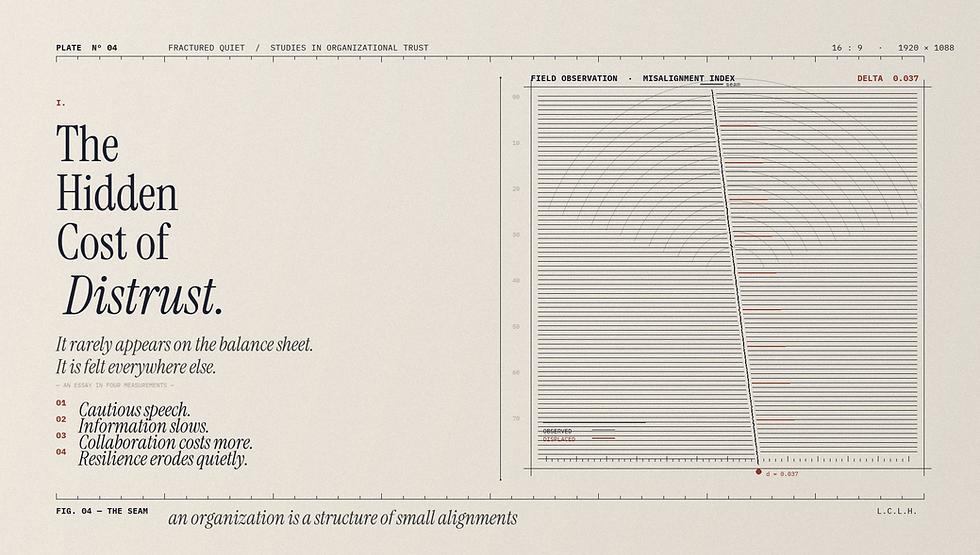
Distrust rarely appears on a balance sheet, but its effects are felt throughout an organization.
When trust is low, employees become more cautious, information flows more slowly, and collaboration requires greater effort. Leaders often interpret these symptoms as engagement, talent, or communication challenges when the underlying issue is trust erosion.
Organizations with high levels of trust tend to adapt more effectively during change because employees are more willing to share concerns, consider new ideas, and support difficult decisions. Trust does not eliminate resistance to change, but it increases openness to understanding the rationale behind it.
For executive leaders, trust should be viewed as organizational infrastructure rather than a soft skill. It influences how quickly decisions are made, how effectively teams align, and how resilient the organization becomes during uncertainty.

How to build trust with your communication
A boss-subordinate relationship and transactional leadership style are not helpful when trying to build trust. The most effective leaders are transparent and vulnerable, and they demonstrate care and respect for others.
Two common themes emerge from research on building trust: transparency and relationships. To communicate effectively, leaders need to understand others' contexts and perspectives and avoid jumping to conclusions too quickly.
In the book, Conversational Intelligence: How Great Leaders Build Trust and Get Extraordinary Results, Judith Glaser provides a helpful way to remember these attributes:
T – Transparency
R – Relationship
U – Understanding
S – Shared success
T – Testing assumptions
Establishing trust during change requires building rapport, inviting and responding to emotions, and explaining the change event clearly and concisely. Communications that create openness to change and build trust include:
Vision
The idealized goal for the organization to achieve in the future. Communication during change events should align with organizational values and provide enough detail so employees can see the roadmap and benefits of the change. The goal is to create positive attitudes toward change and support for change.
Energy
Demonstrating personal excitement. An executive leader's positive emotions and mood are contagious. Research has shown that leadership communication that enables followers to experience positive emotions enhances happiness and well-being. In return, followers' improved positive emotions increase employee motivation, cooperation, and support for change.
Support
Executive leaders demonstrate support by providing encouragement, reassurance, listening, and sharing feelings. Research has found that when individuals receive help, they are more receptive and willing to cooperate with change.
How to be a trustworthy leader
Trust takes place between two people and is earned. Successful businesses are built upon relationships. In his book Trust: The Social Virtues and the Creation of Prosperity, Francis Fukuyama presented that business would not be productive without trust.
The International Coaching Federation has identified six behaviors essential for building trust-based relationships:
Show genuine concern for the other person's welfare and future.
Continuously demonstrate personal integrity, honesty, and sincerity.
Establish clear agreements and keep promises.
Demonstrate respect for others' perceptions, learning styles, and personal being.
Provide ongoing support for and champion new behaviors and actions, including risk-taking and a fear of failure.
Ask permission to coach others in sensitive, new areas.
Trustworthy leadership attributes
Many leaders assume trust is primarily built through expertise and credibility. While credibility matters, it is rarely enough.
Employees often respect leadership competence while simultaneously questioning leadership intentions or consistency. In many organizations, trust failures do not result from a lack of capability. They result from gaps between what leaders say, what leaders decide, and what employees experience.
Leadership trustworthiness is built through four essential attributes:
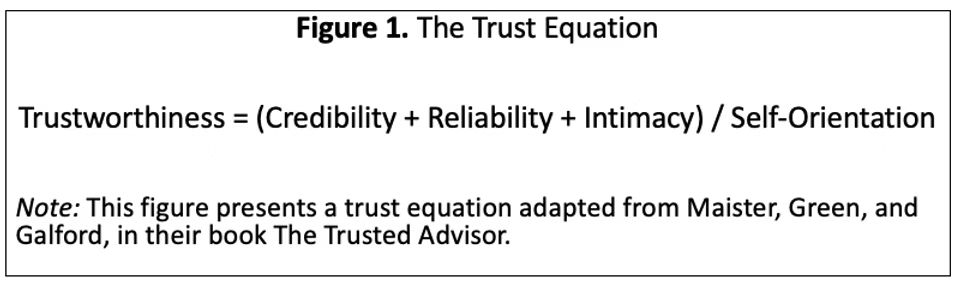
Credibility
Credibility is the most frequently achieved attribute of trustworthiness. However, having the title of leader does not always equate to being perceived as credible. Credibility has rational and emotional aspects related to an individual's expertise and personal presence.
Reliability
Reliability is based on the frequency of interactions with someone and the consistency of expected behavior. Saying what you are doing, doing what you say, and saying what you did matter for building reliability.
Intimacy
Intimacy requires your willingness to be vulnerable and have a courageous conversation when needed. This is one of the key differentiating attributes of trustworthiness.
Self-Orientation (aka. Humility)
Self-orientation refers to the degree of focus on oneself versus on the other person. A high degree of self-orientation creates significant distrust from others. Self-orientation is linked to the leader's conscientiousness, agreeableness, and openness to experience personality traits.
The attributes of trustworthiness (see Figure 1) can be placed into the following equation to measure your trustworthiness.
Are you a trustworthy leader?
High-quality relationships are high-trust relationships. Evidence suggests that improved workplace relationships increase individual and organizational productivity and profitability.
The Relationship Trust Checker is a free quiz you can use to gauge your level of trust in a relationship and identify opportunities to improve your trustworthiness.
"The unexamined life is not worth living." Socrates
Final thoughts
Trust is often viewed as a byproduct of strong leadership. In reality, it is one of the conditions that determines whether leadership can be effective at all.
Employees decide every day whether to share information, raise concerns, collaborate across boundaries, and support change initiatives. Those decisions are influenced by the degree of trust they have in leadership and the organization.
For executive leaders, the question is not whether trust matters. The question is whether organizational systems, decisions, and leadership behaviors consistently reinforce it.
As you reflect on your own organization, consider:
Where is trust accelerating performance?
Where is distrust creating friction?
Do employees trust leadership intentions, leadership competence, or both?
What experiences are shaping trust more than your communications?
The answers may reveal opportunities to strengthen relationships and the organizational conditions that drive long-term success.

References:
Bono, J., & Ilies, R. (2006). Charisma, positive emotions, and mood contagion. The Leadership Quarterly, 17(4), pp. 317-334.
Doolittle, J. (2023). Life-changing leadership habits: 10 Proven principles that will elevate people, profit, and purpose. Organizational Talent Consulting.
Edelman Trust Institute. (2023). 2023 Edelman Trust Barometer: Navigating a Polarized World. Edelman.
Fukuyama, F. (1995). Trust: The social virtues and the creation of prosperity. Free Press.
Glaser, J. (2016). Conversational Intelligence: How Great Leaders Build Trust and Get Extraordinary Results. Routledge.
Men, L. R., Yue, C. A., & Liu, Y. (2020). Vision, passion, and care: the impact of charismatic executive leadership communication on employee trust and support for organizational change. Public Relations Review, 46(3).
Kanfer, R., & Ackerman, P. (1989). Motivation and cognitive abilities: An integrative aptitude-treatment interaction approach to skill acquisition. Journal of Applied Psychology, 74, pp. 657-690.
Maister, D. H., Green, C. H., & Galford, R. M. (2000). The trusted advisor. Free Press.
Shamir, B., House, R., Arthur, M. (1993). The motivational effects of charismatic leadership: A self-concept based theory. Organization Science, 4(4), pp. 577-594
Wanberg, C., & Banas, J. (2000). Predictors and outcomes of openness to changes in a reorganizing workplace. Journal of Applied Psychology, 85 (1), pp. 132-142,


